

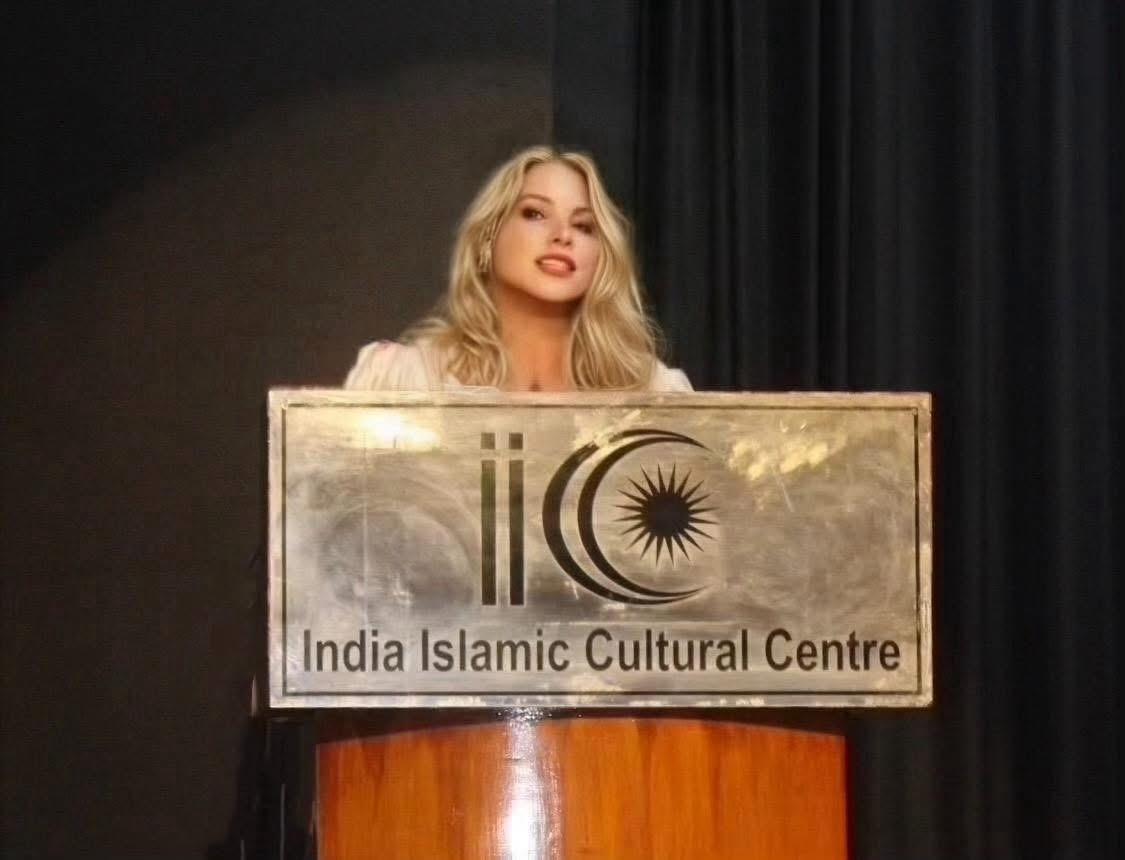
A Conversation with Dr. Virginia Rivera on Rebuilding Economies Through Women
E-Village, India — April 17, 2026: In a world where women’s empowerment is often discussed as a social initiative, Dr. Virginia Rivera offers a fundamentally different perspective—one that challenges the very foundation of how development is designed.
“Women are not something you add to a system,” she explains. “They are the system.”
Speaking after her recent return from India, where she has been working closely with rural communities through the Mahila Udyami Foundation, Dr. Rivera reflects on what she describes as a critical shift in global development thinking: moving from intervention-based models to infrastructure-based design.

Rethinking the Narrative
For decades, governments, NGOs, and global institutions have invested in programs aimed at “empowering women.” While these efforts have created meaningful progress, Dr. Rivera believes they have not gone far enough.
“The language itself is limiting,” she says. “When you frame women as something to empower, you’re already placing them outside the system. You’re saying they need help to enter something that was never designed for them.”
The Data Supports her Argument
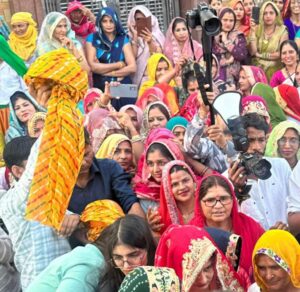
Women represent nearly 48% of India’s population, yet contribute only about 18% to GDP. Global studies suggest that closing gender gaps in labor participation could increase India’s GDP by up to 27%, adding hundreds of billions of dollars in economic value.
“These are not small numbers,” Dr. Rivera emphasizes. “This is not about inclusion for fairness. This is about redesigning economies for efficiency.”
What the Data Doesn’t Always Show
Beyond the macroeconomic figures lies another reality—one that is less visible but equally significant.
In India, over 90% of women work in the informal sector, often without job security, formal wages, or social protections. At the same time, women perform six to nine times more unpaid care work than men, contributing an estimated 15% of GDP in invisible labor.
“They are already sustaining economies,” Dr. Rivera notes. “The problem is not participation. The problem is recognition and access.”
From Theory to Practice: The Mahila Udyami Model
This shift in thinking is not just theoretical—it is being implemented on the ground.
In E-Village, Prayagraj, the Mahila Udyami Foundation is building what Dr. Rivera describes as a women-centered economic ecosystem, designed to move beyond isolated programs.
“We’re not creating a workshop or a training center,” she explains. “We’re building infrastructure—economic, social, and human infrastructure.”
The initiative integrates:
• Skills development
• Financial literacy
• Entrepreneurship support
• Community engagement
The goal is not short-term intervention, but long-term transformation.
The response has been immediate.
“We have 150 women already registered for our first cohort, with a waiting list of over 200 more,” Dr. Rivera shares. “And that tells you something important—women are ready. They’ve always been ready.”
A System Built on Experience
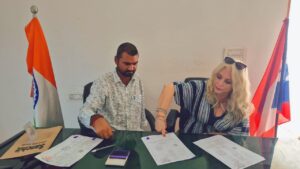
A critical part of this work is the Partnership with Adv. Peeyush Pandit, whose decades of experience in rural development have shaped the foundation of the initiative.
“Adv. Pandit understands rural India in a way that cannot be learned from theory,” Dr. Rivera says. “He has spent years building, observing, and working directly with communities.”
His leadership across sectors—from infrastructure to education to social development—has provided the groundwork for what is now evolving into a scalable model.
“What makes his approach powerful is that it is not fragmented,” she adds. “It connects systems—economic, educational, and social—into something communities can actually sustain.”
Building for Scale, Not Just Impact
Unlike many initiatives that aim for rapid expansion, Mahila Udyami is intentionally starting with a focused approach.
“This first cohort is a learning phase—for all of us,” Dr. Rivera explains. “We are building something that must be replicable, adaptable, and sustainable.”
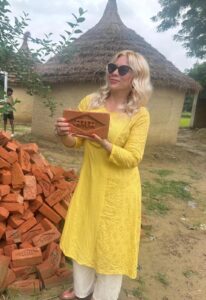
Construction of the Women’s Empowerment and Business Hub is currently underway, with electrical wiring and water systems being installed and structural walls nearing completion. The team aims to complete the roof by July, allowing time to prepare the facility for full-scale operation.
“This is not just a building,” she says. “It’s a foundation for a new way of thinking.”
The Multiplier Effect
What distinguishes this model is what Dr. Rivera calls the “multiplier effect.”
“When a woman gains access, the impact is never isolated,” she explains.
It extends to:
• Her household
• Her children
• Her community
• Her local economy
“And when you scale that,” she adds, “you don’t just change lives—you change systems.”
A Shift the World Can No Longer Ignore
As global conversations increasingly focus on inclusive growth, Dr. Rivera believes the next step is clear.
“We need to stop asking how to empower women,” she says.
“We need to start asking how we design systems where women are already at the center.”
Because, as she puts it:
“The future of development is not inclusion. It is women-led design.”
The Work Ahead
In redefining women as infrastructure rather than intervention, Dr. Virginia Rivera is not simply offering a new perspective—she is challenging the world to rethink how progress itself is built.
And in places like E-Village, that future is already taking shape.
Leave a Reply