

Mahila Udyami Foundation and International Internship University (IIU) bring education, leadership and economic opportunity into a conversation on International Equal Pay Day
ST. THOMAS, U.S. VIRGIN ISLANDS / DELHI, INDIA — September 18, 2026 — Equal pay cannot be solved by discussing salaries alone. That was the central message of The Value of Her Work — A Global Leadership Conversation, convened by Mahila Udyami Foundation in collaboration with IIU in observance of International Equal Pay Day 2026.
Mahila Udyami Foundation brought the economic empowerment, entrepreneurship and ownership perspective to the conversation, while IIU, as the collaborating education institution, brought the education and leadership pillar — reinforcing the idea that economic freedom begins with access to knowledge, opportunity and the ability to translate learning into participation, leadership and ownership.
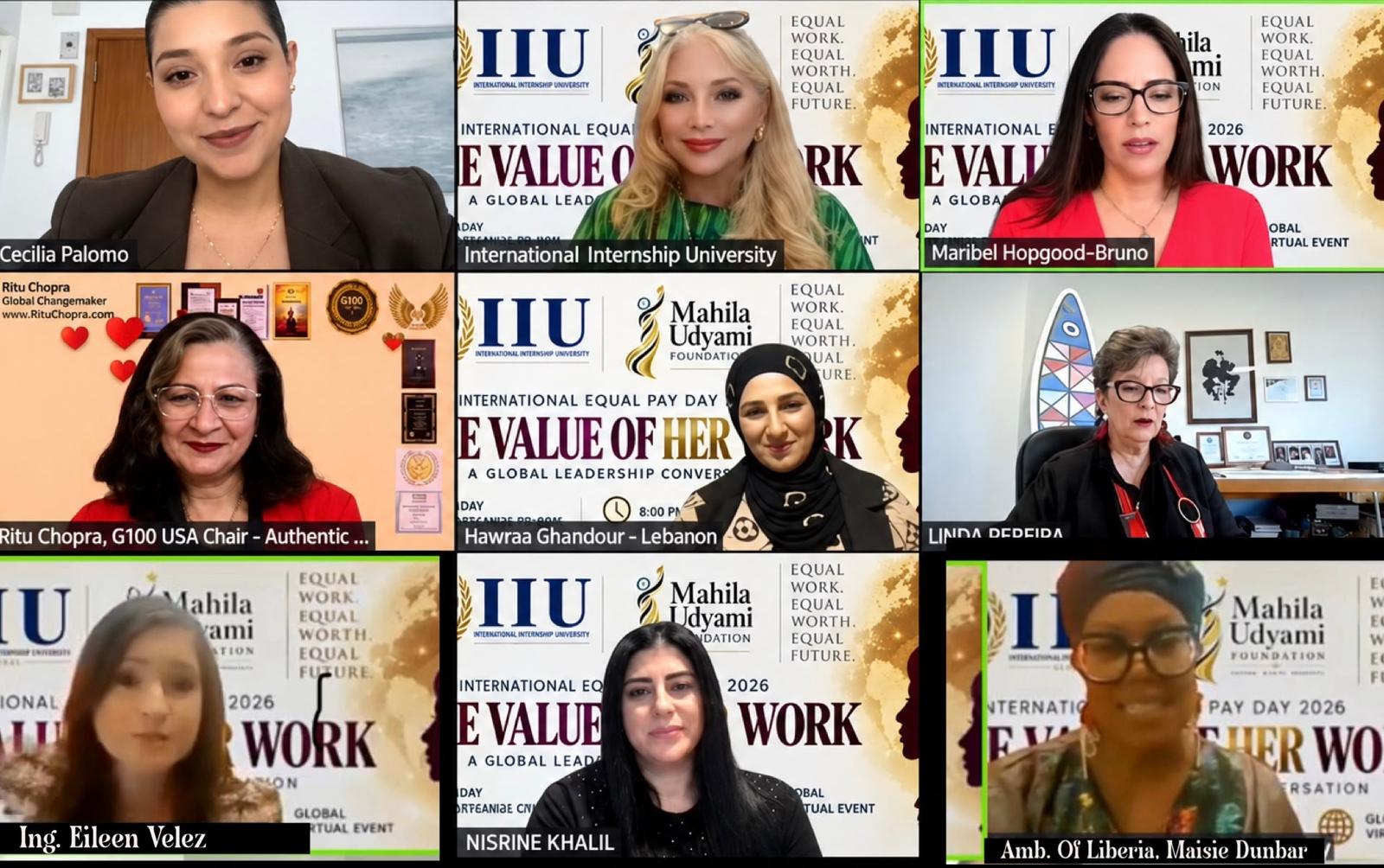
The virtual gathering connected leaders across law, diplomacy, investment, engineering, communications, technology, education and global business around one central question: If women’s work has equal value, what must change now — not only in pay, but in access to leadership, capital, ownership and economic power?
The conversation carried added significance because it took place while the We Mean Business Summit, organized by CEO Sharon Jackson, was underway in St. Thomas, U.S. Virgin Islands — a gathering of elite entrepreneurs and businesswomen focused on leadership, enterprise and changing the narrative.
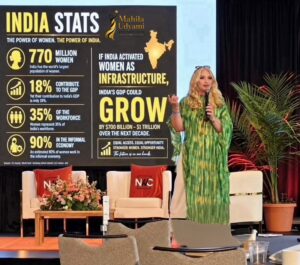
Among the Summit’s keynote speakers was Dr. Virginia Rivera, who brought her Women Are Infrastructure™️ framework into the gathering — connecting a movement that spans Puerto Rico, the Caribbean, the United States and India with a larger conversation about women’s economic participation.
The timing created a powerful real-time connection: women were discussing the systems that shape economic opportunity globally while, simultaneously, entrepreneurs and business leaders in St. Thomas were building businesses, expanding networks and creating opportunities of their own.
Care Has an Economic Cost
Dr. Cecilia Palomo Caudillo of Mexico focused on the economic impact of care work and how women’s disproportionate caregiving responsibilities affect career advancement, earnings and long-term wealth. “We cannot seriously discuss equal pay without discussing care. The responsibility women carry at home follows them into the workplace and into their economic lives.” Her message underscored a central truth: work that is unpaid can still carry enormous economic value — and enormous economic consequences.
Women Must Become Investors and Wealth Builders
Kwamara Thompson of the United States, Founder of Women Invest in Women, emphasized that women must move beyond earning toward investing, ownership and wealth creation. “We have to invest in women knowing they will build wealth. When women gain access to capital, the impact reaches businesses, families, communities and the next generation.” Her contribution moved the discussion from compensation toward one of the most important questions of economic equality: Can women build and retain wealth?
Women Must Insert Themselves Into the Economy
H.E. Ambassador Maisie Dunbar, Special Envoy for Trade and Investment to the President of Liberia, urged women to actively create their own economic opportunities. “Women must insert themselves into the economy. We cannot always wait to be invited. We must enter markets, build businesses and create opportunity.” Her message strongly reinforced the entrepreneurial energy also being seen in St. Thomas through the We Mean Business Summit.
Being the First Woman Should Not Mean Being the Last
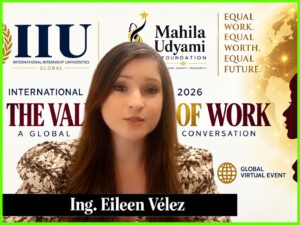
Engineer Eileen Vélez Vega, the first woman to serve as Secretary of Transportation and Public Works of Puerto Rico, reflected on entering spaces historically dominated by men. “Being the first woman is an achievement, but it also shows how long the door was closed. Progress comes when the women behind you no longer have to be first.” Her perspective connected equal pay to something broader: representation, authority, access and institutional power.
Stop Waiting for a Seat. Build the Table.
International business leader Linda Pereira challenged women to move beyond waiting for inclusion. “We have spent too much time asking for a seat at someone else’s table. Sometimes we need to create our own table — and decide who we invite.” Her message reflected one of the strongest themes of the event: women must move beyond seeking permission and toward building their own platforms, enterprises and spaces of influence.
Investing in Women Is an Economic Strategy
Ambassador Ritu Chopra, technology leader, executive coach and author of Investing in Women, emphasized the broader economic return of supporting women. “Investing in women is not charity. It is an economic strategy. When women have resources, capital and access, the return reaches far beyond one individual.” Her remarks reinforced the idea that women should not be positioned simply as beneficiaries of economic systems, but as central contributors to innovation, growth and wealth creation.
From Equal Pay to Economic Power: Women Are Infrastructure™️
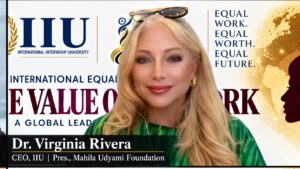
For Dr. Virginia Rivera, CEO of International Internship University, Chair and Co-Founder of Mahila Udyami Foundation and creator of Women Are Infrastructure™️, the significance of International Equal Pay Day lies in understanding where pay fits within a much larger economic framework. Her Women Are Infrastructure™️ — Economic Freedom Pathway™️ moves the conversation through Autonomy → Ownership → Capital, connecting a woman’s ability to make economic choices with her ability to build assets, hold a stake and create long-term growth.
Rivera explained: “International Equal Pay Day matters because pay is one part of a much larger economic journey. Equal compensation can create greater autonomy, but autonomy must lead to ownership, ownership must create access to capital, and capital must create the ability to grow, build wealth and leave a legacy. That is why we say Women Are Infrastructure. Women are not a side conversation in the economy — they are part of the system that keeps it functioning.”
Her message connected the online global conversation directly with the work she was simultaneously advancing as a keynote speaker at the We Mean Business Summit in St. Thomas.
From Puerto Rico to India, the framework is being used to challenge the idea that women’s economic progress should be measured only by workforce participation or salary. The larger question is whether women have the power to choose, own, invest, build and grow. Rivera added: “A woman can earn a salary and still own no assets or equity. Equal pay matters deeply, but the destination must be economic power. If we truly value her work, that value must be reflected in access, leadership, ownership, capital and the ability to build wealth and legacy.” That philosophy sits at the intersection of the two institutions behind The Value of Her Work.
Mahila Udyami Foundation focuses on creating pathways for women toward entrepreneurship, ownership, financial autonomy and prosperity. International Internship University, as the collaborating education institution, brings the education, knowledge and leadership infrastructure needed to help women translate opportunity into long-term economic participation.
Together, the organizations are advancing a simple but far-reaching idea: Education must lead somewhere. It must lead to opportunity. Opportunity must lead to participation. Participation must lead to leadership. Leadership must lead to ownership. And ownership must create pathways to capital, growth and economic freedom.
Maribel Hopgood Brought the Journalist’s Lens
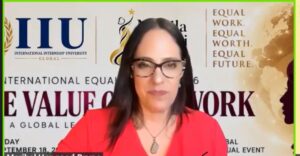
Maribel Hopgood, journalist, news anchor and Chief Communications Officer of Mahila Udyami Foundation, brought focus and immediacy to the conversation. Drawing on her journalism and broadcast background, Hopgood moved beyond ceremonial questions and pushed speakers directly toward the heart of the issue: “If women’s work has equal value, what must change now — not only in pay, but in leadership, capital, ownership and economic power?” Her ability to connect differing perspectives and get directly to the point gave the event the energy of a global news conversation rather than a traditional conference panel.
The fact that The Value of Her Work unfolded while the We Mean Business Summit was taking place in St. Thomas added another dimension to International Equal Pay Day. In one space, women were examining the systems that influence compensation, ownership and economic opportunity. In another, women entrepreneurs and business leaders were actively building businesses, expanding networks and changing the narrative. And connecting both spaces was a framework increasingly being carried across borders:
Women Are Infrastructure™️
From Puerto Rico and the U.S. Virgin Islands to India, the message is the same: Women are not waiting for the future economy. They are already building it. The question now is whether institutions, markets, governments, investors, employers and educational systems will build structures that recognize their full economic value. Equal Work. Equal Worth. Equal Future. Because the value of her work should not be measured only by what she earns. It should also be measured by what she has the power to choose, own, build, grow, influence and leave behind.
Leave a Reply