

United States | July 24, 2026
What if the greatest barrier facing women today is not a lack of talent, ambition, or determination?
What if it is the absence of systems designed to support their success?
That question was at the heart of Session 5 of the Women Are Infrastructure Masterclass, hosted by Dr. Virginia Rivera, CEO of the International Internship University (IIU), as part of Women’s Economic Empowerment Wednesdays—a global educational initiative created through the collaboration of the International Internship University (IIU) and the Mahila Udyami Foundation.
The session challenged one of the most widely accepted assumptions in women’s development: that empowering individual women alone is enough to create lasting social change.
“It is not,” Dr. Rivera explained.
“Empowering one woman changes one life. Building systems changes generations.”
For decades, governments, nonprofit organizations, universities, and international agencies have invested billions of dollars in programs designed to empower women. Scholarships have been awarded. Businesses have been launched. Leadership courses have been delivered. Countless lives have been transformed.
Yet despite these efforts, many of the same structural barriers remain.
Women continue to face unequal access to leadership opportunities, affordable childcare, quality education, mentorship, financial services, professional networks, and representation in decision-making.
According to Dr. Rivera, the challenge is not a lack of capable women.
It is the lack of systems that consistently allow women to succeed.
From Individual Success to Collective Transformation
During the masterclass, Dr. Rivera introduced a systems-based approach to women’s economic empowerment—one that shifts the conversation from helping individual women toward creating environments where success becomes sustainable and repeatable.
“The true measure of leadership is not how many people we help ourselves. It is whether we build institutions and systems that continue helping people long after we are gone.”
This philosophy represents the foundation of the Women Are Infrastructure framework, a model developed by Dr. Rivera that recognizes women not as beneficiaries of development, but as essential contributors to the social, economic, and institutional infrastructure of every society.
When women thrive, families become stronger.
When families become stronger, communities become more resilient.
When communities become more resilient, nations prosper.
Building the Infrastructure for Women’s Success
Session 5 explored six essential pillars required to create sustainable systems that support women throughout their lives and careers.
• Education must move beyond access to become lifelong learning that prepares women to adapt, innovate, and lead.
• Entrepreneurship must be viewed not simply as business creation but as community development and economic resilience.
• Mentorship must become intentional, ensuring every generation prepares the next.
• Public Policy must remove barriers while expanding opportunity and representation.
• Partnerships between governments, universities, businesses, nonprofits, and communities must replace isolated efforts with collaborative action.
• Legacy Leadership requires building institutions capable of creating opportunity for decades—not just programs that last a season.
Building systems also requires rethinking the role of the private sector.
Organizations cannot expect women to compete equally while continuing to design workplaces around outdated assumptions. Professional development, executive education, certifications, networking events, mentoring, and leadership training are often scheduled after working hours or on weekends—the very time when many women continue to shoulder the majority of unpaid care responsibilities.
When learning happens only outside the workday, women are too often forced to choose between advancing their careers and caring for their families. Over time, this widens the leadership gap, the skills gap, and ultimately the economic gap.
If we are serious about women’s economic empowerment, the workplace itself must become part of the solution.
Employers should integrate professional development into paid working hours whenever possible. Flexible work schedules, hybrid work models, protected learning time, and family-supportive workplace policies are not simply employee benefits—they are strategic investments in talent, innovation, and long-term organizational success.

As Dr. Rivera emphasized during the session:
“Women’s economic empowerment cannot depend on women finding more hours in the day. We must build workplaces that recognize the realities of women’s lives. When organizations invest in learning during the workday, support flexible work arrangements, and create pathways for continuous growth, they are not simply supporting women—they are building stronger businesses, stronger economies, and stronger societies.”
These are not separate initiatives.
Together, they form the infrastructure that allows women to flourish.
A Global Collaboration for Lasting Impact
The Women Are Infrastructure Masterclass is part of Women’s Economic Empowerment Wednesdays, an international educational initiative jointly presented by the International Internship University (IIU) and the Mahila Udyami Foundation.
Designed by Dr. Virginia Rivera, the initiative reflects years of research, executive leadership, and international collaboration dedicated to advancing women’s economic participation, leadership, and long-term prosperity.
Each Wednesday, two complementary masterclasses offer participants a comprehensive leadership journey.
The first, Women Are Infrastructure, explores the systems, policies, investments, and leadership models required to strengthen families, communities, and nations through women.
The second, Executive Leadership, Presence & Global Influence, led by H.E. Ambassador Jeannette Matta, equips women with the executive presence, confidence, communication, visibility, and strategic influence necessary to lead within those systems.
Together, the programs bridge theory and practice.
They prepare women not only to participate in change—but to design it.
Participants who were unable to attend live can watch previous Women Are Infrastructure sessions on the International Internship University Facebook Page and the IIU YouTube Channel, where each masterclass remains available as a growing educational resource for women, educators, entrepreneurs, policymakers, and global leaders.
The series continues to build a permanent library of ideas, strategies, and practical frameworks that support women around the world.
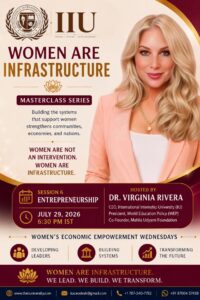
Coming Next: Session 6 — Entrepreneurship
The conversation continues next Wednesday with Session 6: Entrepreneurship – Building Economies from the Ground Up, where Dr. Rivera will explore entrepreneurship not simply as the creation of businesses, but as the creation of systems that generate opportunity, employment, innovation, and resilient local economies.
Participants will examine how women entrepreneurs become architects of economic growth and why entrepreneurship is one of the most powerful forms of infrastructure a society can build.
The session will also explore how access to capital, mentorship, markets, technology, and strategic partnerships can transform women-owned businesses into engines of economic development that strengthen entire communities.
A New Conversation
As conversations around women’s empowerment continue to evolve, Dr. Rivera believes the next frontier is no longer access alone.
It is architecture.
“We have spent decades asking how we can empower women,” she reflected during the session.
“Perhaps it is time to ask a different question: What systems are we building that ensure women never have to overcome the same barriers again?”
The answer to that question may define the future of economic development.
Because sustainable progress is not measured by the number of successful individuals.
It is measured by the strength of the systems that make success possible for everyone.
That is the essence of the Women Are Infrastructure movement.
It is a call to governments, educational institutions, businesses, nonprofits, and communities to move beyond isolated programs and begin designing systems that create opportunity for generations.
Because women are not simply participants in society.
They are the architects, builders, and leaders of our collective future.
When we invest in women, we are not simply investing in individuals.
We are investing in the infrastructure that powers stronger families, resilient communities, thriving economies, and prosperous nations.
Wome are infrastructure.
Leave a Reply